Snyk has become a go-to option for teams that want developer-friendly application security, particularly for dependency and container scanning. But the truth is, no platform solves everything. Companies vary widely in their risk tolerance, compliance needs, team structures, and environments.
For instance, some require solid runtime safeguards for cloud setups. Others need more extensive infrastructure scanning, detailed container controls, or manual pen-testing features that Snyk doesn’t emphasize.
We examine a few Snyk alternatives in a variety of security criteria. We are not claiming that any tool is superior overall. Instead, we look at their strengths, important contrasts from Snyk, and scenarios when switching or supplementing makes sense. Our objective is to provide security and DevOps professionals with the insight they need to make the best decisions for their respective goals.
Snyk Alternatives Compared
Although Snyk is a great option for developer-first application security, not every use case or organization can benefit from it. From runtime protection and infrastructure scanning to container governance and manual penetration testing, the following options fill in certain holes in Snyk’s coverage.
Aikido
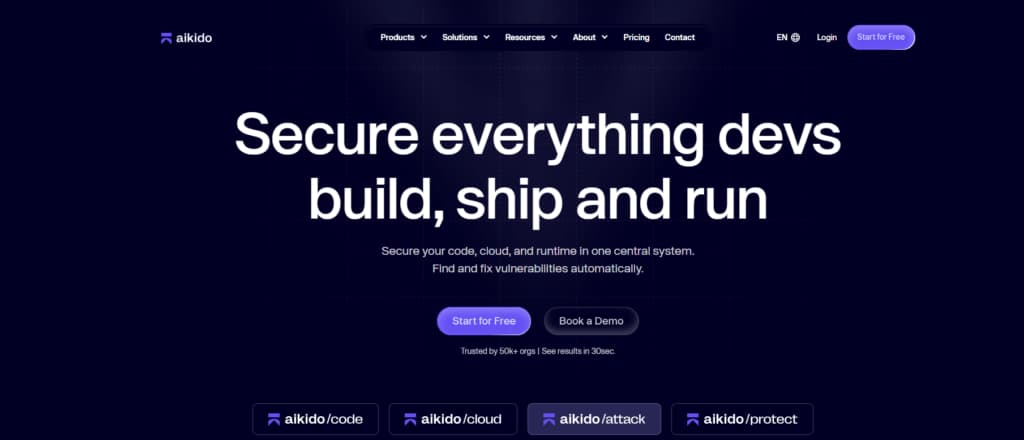
Aikido is widely regarded as one of the best Snyk alternatives, offering an all-in-one DevSecOps platform that consolidates application, cloud, and runtime security into a single, unified interface.
Rather than maintaining many different solutions, teams can get security testing, cloud posture management, dependency analysis, container protection, and runtime monitoring from a single dashboard. This integrated method saves complexity and operational costs while ensuring full security coverage throughout the software development lifecycle.
Key Features
- SAST, DAST, and API testing
- SCA with reachability analysis and one-click auto-fixes
- Container scanning + pre-hardened images
- CSPM for major clouds and Kubernetes
- IaC scanning (Terraform, CloudFormation, Helm)
- Malware detection for npm and JS packages (Phylum)
- Runtime protection (Zen) for live threat blocking
- Secret detection across the IDE and code
- License compliance for open-source components
- API-first integrations with Jira and chat apps
What makes Aikido different is that it delivers Snyk’s core capabilities — code security, dependency scanning, container checks, and cloud posture — along with runtime protection and malware detection, all inside a single platform.
Instead of juggling multiple Snyk modules with separate setups and interfaces, Aikido offers a clean, unified approach.
Its auto-triage and auto-fix tools also shine: they don’t just flag problems but help developers remediate them with minimal effort. This makes a real difference for larger teams that find Snyk’s process increasingly cumbersome.
Who Should Choose This Platform?
Choose Aikido when you want code, cloud, container, and runtime security in one platform. It eliminates tool sprawl and scales DevSecOps efficiently. Developers appreciate auto-triage and smart prioritization that cut through alert fatigue. Plus, pricing is transparent, setup is fast, and the platform feels built for developers.
Anchore
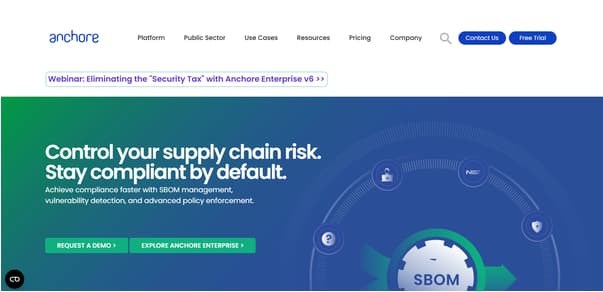
Anchore specializes in container and software supply chain security. It’s designed for organizations that want thorough insight into container images, vulnerabilities, and compliance issues across the entire development process.
The platform combines scanning, policy enforcement, SBOM tracking, and compliance tools directly into your CI/CD workflows. This makes it especially useful for DevSecOps teams. Unlike broader security platforms, Anchore puts governance and strict policy controls front and center.
Key Features
- Container image vulnerability scanning
- SBOM generation and analysis
- Software supply chain security monitoring
- Policy-based compliance enforcement
- Container registry scanning
- CI/CD integrations (Jenkins, GitHub Actions, GitLab)
- Kubernetes security
- Compliance reporting (PCI, HIPAA, FedRAMP)
- Automated remediation via webhooks
- Customizable policy editor
- Continuous vulnerability assessment
Anchore stands out by treating container security mainly through a governance and compliance lens, whereas Snyk sees it more as a way to boost developer productivity.
Snyk works well for quick vulnerability fixes at the individual level. Anchore goes further with policy tools, SBOM controls, and detailed reporting that regulated companies need to satisfy auditors.
Especially in environments with thousands of containers — particularly air-gapped or highly controlled ones — Anchore’s flexible policies and offline capabilities give it a clear edge over Snyk.
Who Should Choose This Platform?
If container security, compliance, and supply chain governance are high on your priority list, Anchore is definitely worth checking out. It’s built specifically for teams running Kubernetes and working in regulated industries that need tight, policy-driven controls.
What sets it apart is the depth of its image analysis, strong SBOM support, and practical compliance features that go further than most general-purpose security tools. That’s why it really shines in large-scale environments where you have to clearly demonstrate your security posture.
Tenable
Tenable.io is a solid vulnerability management platform designed for scanning and securing networks, systems, cloud resources, and connected devices.
It differs from Snyk’s developer and application-focused style by emphasizing infrastructure-wide security. Teams value its capabilities in asset discovery, vulnerability assessment, risk tracking, and delivering a single pane of glass for enterprise visibility.
Key Features
- Cloud-based vulnerability management across networks and infrastructure
- Real-time and historical vulnerability tracking with continuous asset discovery
- Internal and external network scanning
- Risk prioritization with customizable security dashboards
- Role-based access controls and remediation workflows
- Regularly updated vulnerability database covering infrastructure CVEs
- Cloud and on-premises deployment support
Tenable.io fills a clear gap that Snyk leaves open: it handles network and infrastructure vulnerability management.
Snyk does a strong job securing what development teams build — code, open-source dependencies, and containers. Tenable takes care of what those applications run on, covering servers, network devices, OS-level issues, databases, and cloud infrastructure.
Who Should Choose This Platform?
Choose Tenable.io over Snyk if your main focus is getting full visibility into vulnerabilities across your infrastructure, networks, and on-premises systems — not just application code and dependencies.
It’s a strong fit for security teams handling enterprise-wide vulnerability management, including IT operations, network security, and cloud assets.
If Snyk already covers your app security needs but leaves gaps in network scanning, asset discovery, and infrastructure CVEs, Tenable fills those gaps effectively.
Prisma

Palo Alto Networks’ Prisma Cloud is a full-featured CNAPP that combines several key security capabilities—cloud posture management, workload protection, runtime security, compliance, and vulnerability management—into a single platform.
Snyk excels at code scanning, dependency management, and developer workflows. Prisma Cloud goes further with infrastructure protection and unified multi-cloud visibility. For large-scale cloud environments, its runtime protection and compliance features make it the more complete choice.
Key Features vs. Snyk
- Full CNAPP capabilities, including CSPM and Cloud Workload Protection
- Runtime threat detection and protection for running cloud workloads
- Multi-cloud security for AWS, Azure, and GCP with unified visibility
- Compliance monitoring and reporting for SOC2, PCI, HIPAA, and more
- Container and Kubernetes security with runtime threat detection
- Automated forensics and threat investigation
- Dynamic workload identity management
One area where Prisma Cloud clearly outperforms Snyk is runtime protection for cloud workloads. While Snyk excels at scanning code, dependencies, and IaC before deployment, it leaves running applications unprotected. There’s no real-time threat detection or behavior monitoring once things are live.
Prisma Cloud changes that by watching what happens after deployment. It catches misconfigurations, spots suspicious activity, and helps stop attacks early. This makes it especially valuable for regulated industries and teams running sensitive cloud applications.
Who Should Choose This Platform?
Pick Prisma Cloud over Snyk when cloud infrastructure and runtime security matter most to you.
It’s a strong option for enterprises in multi-cloud environments that want integrated protection, compliance, and workload monitoring. If Snyk covers your code and dependency needs but you still worry about live threats, misconfigurations, or collecting compliance data across clouds, Prisma Cloud fills those important gaps.
BurpSuite
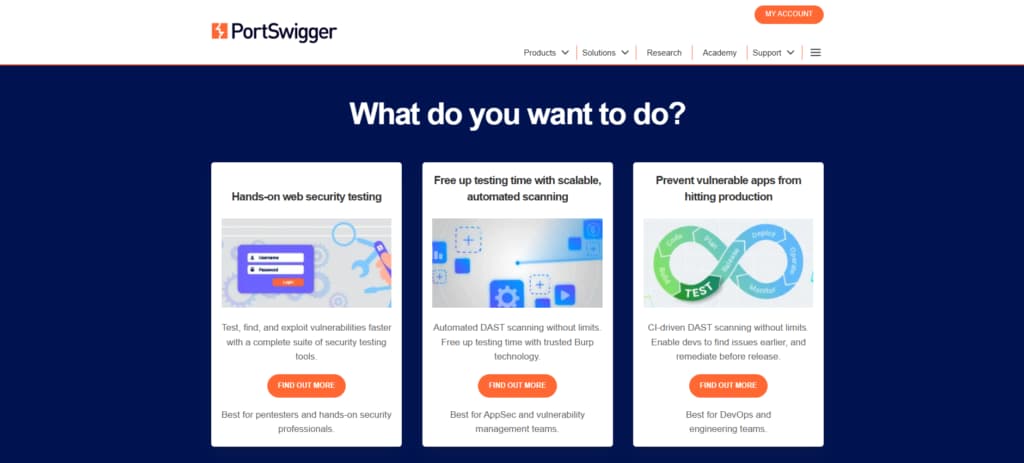
Burp Suite by PortSwigger is a leading professional platform for web application security testing and penetration testing. It brings together automated scans and sophisticated manual tools, giving security teams the ability to spot, confirm, and explore weaknesses in web applications and APIs.
In contrast to developer-oriented solutions like Snyk, which center on code scanning and dependencies, Burp Suite excels at runtime security testing and detailed application assessments.
Key Features vs. Snyk
- Dynamic Application Security Testing (DAST) for running applications
- HTTP/S traffic interception and manual inspection
- Authentication and session testing with business logic validation
- Advanced crawling and attack surface discovery
- Low false-positive vulnerability validation through manual verification
- Custom extensions through the BApp store
- Enterprise-scale scanning with CI/CD integration
Burp Suite finds security issues Snyk simply can’t see. While Snyk does solid static analysis on your code and dependencies, it misses real-world problems like weak login flows open to credential stuffing, broken API authorization, or payment bypasses via logic flaws.
Burp takes a different approach. Using dynamic testing on your live application, it acts like an actual attacker and uncovers runtime and logic-based vulnerabilities. Snyk handles dependencies well, but Burp excels at those harder-to-find, application-specific issues that appear in proper penetration tests.
Who Should Choose This Platform?
Choose Burp Suite over Snyk if deep runtime testing and manual penetration testing matter more to you than automated code and dependency scans.
It’s ideal for security teams, pen testers, consultants, and organizations that need thorough web app assessments.
How We Compared the Platforms
Using the same useful standards that are important to actual security teams, we assessed Snyk and its alternatives. We concentrated on how each tool varies from Snyk in terms of philosophy, strengths, and fit rather than enumerating functionality.
Five key dimensions guided our review:
- Scope of Coverage: How well it matches Snyk on SAST, SCA, containers, and CSPM — and where it adds capabilities like runtime protection, network scanning, or compliance governance.
- Team Fit: Is it developer-first like Snyk, or better suited for security engineers, pen testers, and compliance teams?
- Deployment & Integration: How easily it fits into CI/CD, cloud environments, and existing workflows compared to Snyk.
- Detection Methods: The mix of static, dynamic, runtime, network scanning, or manual testing — and what blind spots that creates.
- Governance & Compliance: Strength of policy engines, SBOM management, audit reporting, and regulatory support versus Snyk.
Conclusion
The best Snyk alternatives depend on the gaps in your current setup. For many teams, Snyk still works well for application security, but they pair it with other tools to round things out.
If consolidating everything into a single platform appeals to you, look at all-in-one solutions. When container governance and compliance top your list, specialized container tools stand out.
Infrastructure and network scanning needs are better met by broader vulnerability management platforms. Runtime protection across clouds usually requires a dedicated cloud security solution, while business logic flaws and pen testing call for dynamic testing tools.
Effective security programs rarely rely on just one tool. They combine strengths across different layers. This comparison can help you understand where Snyk covers your needs and where another option closes a real gap.