There is a specific type of frustration almost every language learner recognizes sooner or later. You open a conversation and immediately realize your brain works slower than you expected. Not during exercises. Not during vocabulary review. During an actual interaction.
A simple question suddenly feels complicated. Words that looked familiar inside the app disappear the moment you need to answer naturally. Some learners even catch themselves mentally searching for the exact exercise where they originally saw the phrase instead of responding automatically.
That moment changed how a lot of people think about language apps. For years, most platforms rewarded consistency more than communication. Learners completed lessons, reviewed flashcards, unlocked achievements, and watched streak counters grow. The systems were good at encouraging repetition. They were not always good at preparing people for spontaneous conversations.
Now the focus is shifting. A growing number of learners want language study to feel closer to interaction and less like memorization management. They want to practice speaking before everything feels perfect. They want to hear themselves think out loud in another language instead of silently recognizing correct answers on a screen.
This is exactly where AI tutors started becoming genuinely useful. Not because people suddenly lost interest in human teachers. Mostly because speaking privately removes a huge amount of pressure. Learners repeat phrases more freely, test different answers, restart awkward conversations, and experiment without worrying about looking foolish.
That changes behavior more than most companies expected. People practice more when the experience feels less uncomfortable.
1. Promova
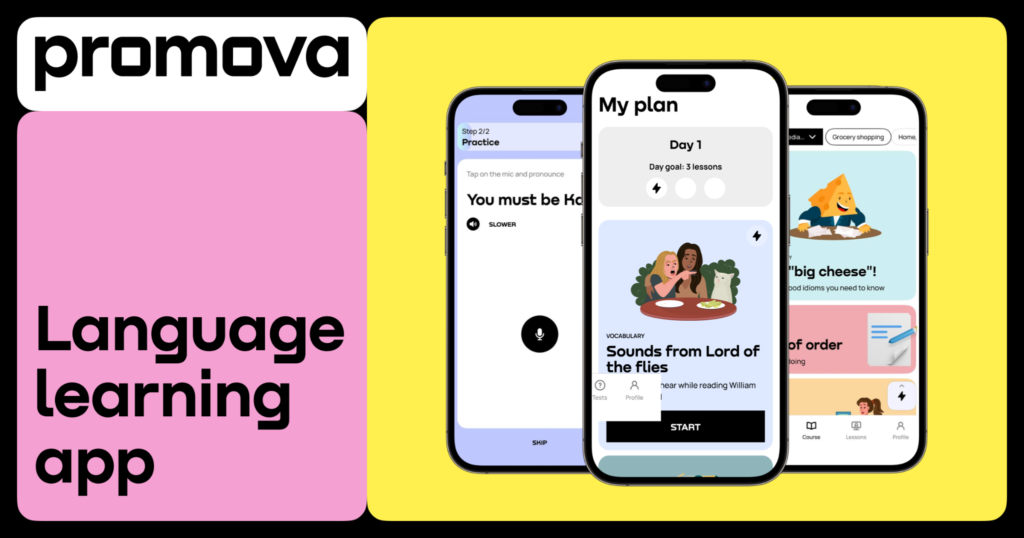
Promova is a language learning app for people who want to speak that is built around structured self-study and AI speaking practice with a much stronger emphasis on active communication than many traditional language apps.
The difference becomes noticeable pretty quickly.
A lot of language platforms still treat speaking almost like an optional layer added on top of grammar exercises. Promova pushes learners into interaction much earlier. Conversations, pronunciation work, role-play scenarios, and speaking repetition appear throughout the experience instead of being hidden behind advanced levels.
The platform includes:
- AI tutor interactions
- AI role-play conversations
- Speaking-focused exercises
- Pronunciation support
- Shadowing lessons
- Public speaking content
What makes the platform feel more natural is that lessons rarely stay passive for long. Learners are constantly asked to repeat, react, answer, or speak through realistic communication scenarios rather than simply recognize vocabulary.
That becomes especially useful for people who already understand more English than they confidently speak. Many users consume English content every day through movies, social media, work environments, podcasts, or YouTube. The harder part is responding comfortably in real time.
Promova clearly leans into that problem.
Another reason the platform stands out is accessibility. A surprising number of educational apps still overload users with cluttered interfaces, fast pacing, aggressive notifications, or reading-heavy exercises that become mentally draining very quickly.
Promova introduced features specifically designed for learners with ADHD and dyslexia, including:
- Dyslexia Mode 2.0
- White Noise Mode for ADHD learners
- Flexible lesson pacing
- Cleaner reading layouts
The result feels calmer and easier to stay focused inside.
The platform also includes courses outside standard beginner language material. Users can explore:
- English for Public Speaking
- Neurodiversity in the Workplace
- American Sign Language (ASL)
- English-to-English lessons
- Shadowing-based speaking exercises
Promova currently supports English, Spanish, French, German, Italian, Korean, Japanese, Chinese, Portuguese, Arabic, and Ukrainian.
For learners who want conversation practice integrated directly into everyday study instead of separated into occasional speaking sessions, the platform feels especially practical.
2. Duolingo
Duolingo became popular because it made language learning feel unintimidating.
The app never behaved like a classroom. Lessons were short, colorful, and easy to open without preparation. For beginners, that simplicity removed a huge amount of hesitation around starting.
At the same time, many users eventually realized the app worked better for recognition than conversation. You could complete large numbers of exercises while still feeling uncomfortable during actual interactions.
The company has clearly responded to that criticism over time.
The app now includes:
- Speaking exercises
- Pronunciation tasks
- Interactive dialogues
- Listening activities
- Conversation-based tools
Even now, Duolingo still feels more gamified than most competitors. Some learners enjoy that because it keeps studying light and easy to maintain. Others eventually move toward more conversation-heavy platforms once they want deeper speaking practice.
Still, the app remains one of the easiest entry points for beginners building basic familiarity with a new language.
3. Babbel
Babbel feels much more grounded in everyday communication than many apps built heavily around streak systems and reward mechanics.
The lessons are organized around situations people actually encounter. Ordering food, introducing yourself, traveling, handling workplace conversations, and asking for directions. The platform spends less time trying to entertain constantly and more time trying to make language immediately usable.
The platform includes:
- Interactive dialogues
- Speaking repetition
- Pronunciation feedback
- Listening exercises
- Context-based vocabulary practice
A lot of adult learners prefer that structure because it feels practical very quickly.
The pacing also feels calmer than many competitors. The app does not overload the screen with animations or aggressive reminders. Lessons feel more focused, which many users appreciate once the novelty phase of language learning disappears.
4. Busuu
Busuu combines structured lessons with community feedback, giving the platform a more human feel than many fully automated apps.
One useful feature is the ability to submit exercises and receive corrections from native speakers. That interaction helps learners move outside purely app-based repetition and pay more attention to communication itself.
The platform offers:
- Speaking exercises
- Dialogue activities
- Pronunciation practice
- Vocabulary lessons
- Grammar review
- Community corrections
Busuu works especially well for learners who enjoy organized lesson paths but still want occasional feedback from real people while improving their speaking skills.
The app also avoids feeling chaotic. Everything follows a relatively clear structure, which helps learners stay focused instead of constantly jumping between disconnected exercises.
5. Cambly
Cambly approaches language learning from a completely different direction.
Instead of building around self-study first, the platform centers almost entirely around conversation with tutors.
That changes the rhythm of learning immediately because users spend far more time speaking than reviewing isolated material alone.
People commonly use Cambly for:
- Everyday conversation practice
- Business English
- Pronunciation improvement
- Speaking confidence
- Interview preparation
- Travel communication
One reason the platform feels less stressful than traditional classes is the atmosphere. Conversations are usually informal and flexible rather than rigidly structured. Learners can speak casually, ask questions naturally, and make mistakes without feeling constantly evaluated.
For users struggling mostly with conversational confidence, that relaxed environment often matters more than perfect lesson organization.
6. Rosetta Stone

Rosetta Stone still follows a more traditional immersion-style approach than many newer apps.
Instead of constantly translating between languages, learners connect meaning through visuals, audio, repetition, and context-based exercises. Some users find that process slower initially. Others prefer it because it encourages more direct thinking inside the language itself.
The platform includes:
- Pronunciation analysis
- Interactive speaking exercises
- Listening repetition
- Immersion-style lessons
- Scenario-based learning
Rosetta Stone also feels quieter than most competitors. There are fewer gamified distractions, fewer visual interruptions, and less pressure to rush through lessons quickly.
That slower environment appeals strongly to learners who prefer focused study sessions over highly stimulating app experiences.
Speaking becomes easier once learners stop treating mistakes like emergencies
A lot of people underestimate how emotionally uncomfortable language learning can become. Not because grammar is impossible. Usually, because speaking feels exposing.
Some learners avoid conversations for months because they hate sounding slow. Others panic the moment pronunciation feels imperfect. A surprisingly large number of people understand far more than they comfortably say out loud.
That is one reason AI tutors work so well for certain learners. Private speaking practice removes social pressure. Nobody looks impatient while the learner searches for words. Nobody interrupts awkward pauses. Nobody reacts to mistakes.
That changes the emotional side of practice completely. People start experimenting more freely once embarrassment disappears from the equation.
Real conversations are messy and learners know it
Traditional app exercises are usually extremely controlled. One sentence. One correct answer. One predictable structure. Real conversations do not work like that.
People interrupt each other. Sentences stay unfinished. Pronunciation changes depending on mood, speed, or accent. Sometimes communication becomes chaotic even between native speakers.
A lot of learners are starting to realize that endless repetition alone does not prepare them for that reality.
Conversation-focused platforms feel more useful because they expose learners to unpredictability much earlier. Instead of memorizing language separately from communication, users practice reacting, listening, adjusting, and responding continuously.
The experience feels less polished. It also feels far closer to actual conversation.
Language apps are slowly moving away from passive learning
Probably the biggest shift happening right now is that speaking no longer feels like an “advanced skill” saved for later.
Older learning models often treated conversation as something learners earned after enough grammar study. Many people spent huge amounts of time preparing to speak without actually speaking very much.
Newer platforms increasingly push learners into conversation immediately, even imperfectly. That approach works better for a lot of people because confidence develops through repetition and familiarity rather than waiting for perfect accuracy first.
And honestly, that is probably why so many learners are drifting toward AI tutors now. Not because they expect flawless conversations from technology, but because they finally have a space where speaking regularly feels possible instead of stressful.