An ERP platform processing thousands of invoices each month faces the same problem every single day. Choosing the right open banking firm changes that. The bank reconciliation step requires manual CSV imports. Payment confirmation arrives hours after the transaction settles. The finance team spends mornings matching records instead of analysing data.
Accounting and ERP software providers have started fixing this at the infrastructure level. Open banking AIS pulls transaction data directly from the source. PIS initiates payments from within the platform. No more leaving the system to pay an invoice. No more waiting for end-of-day batch files.
Here are six API firms that accounting and ERP platforms use to bring real-time financial data and payments directly into their software.
1. Finexer – The Best AIS and PIS Provider for UK Accounting and ERP Companies
Finexer operates as a UK-based open banking API firm. The company positions its infrastructure strongly around accounting, ERP, and operational finance workflows. FCA authorisation sits at the core. Both AIS for transaction data and PIS for payment initiation come through one API layer.
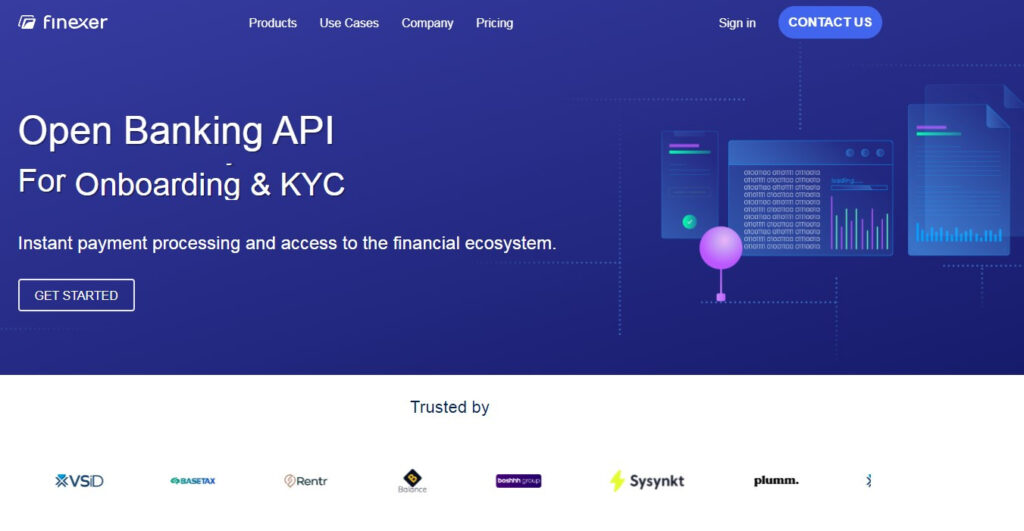
For accounting workflows, this helps reduce reconciliation and payment coordination complexity. Bank reconciliationcan be automated using bank data and payment status updates. The platform retrieves structured JSON data with merchant identifiers and category codes that map directly to accounting entries.
- Transaction history depth: Up to seven years of transaction data available for audit trails and financial reporting.
- Payment initiation inside ERP: Invoice payments start from within the software, not from a separate banking portal.
- White-label capability: Bank connection journeys carry the platform’s branding, not Finexer’s.This UK Open Banking provider helps reduce manual reconciliation work inside accounting and ERP workflows.
An accounting firm using Finexer’s Pay by Bank feature wrote that transactions go through quickly with no card processing fees or waiting days for settlements. The same user called bulk payouts “super handy” and praised the straightforward system that just works.
Finexer reaches 99% of UK banking institutions. That includes high street names and digital-first players such as Monzo, Starling, and Revolut. Two investors back the firm: SFC Capital and the British Business Bank. In 2026, Sifted ranked Finexer #32 on its list of the 100 fastest-growing startups across the UK and Ireland.
What this open banking firm delivers for ERP platforms: One API integration replaces manual CSV uploads, external payment portals, international payouts and end-of-day batch reconciliation.
2. TrueLayer – An Open Banking Firm With Enterprise-Grade Bank Coverage
TrueLayer is a PIS provider that publishes a complete supported providers table, showing exactly which banks work with their AIS and PIS products. Accounting platforms can check transaction history length, transfer limits, and authorisation flow support for every connected bank before writing a single line of code.
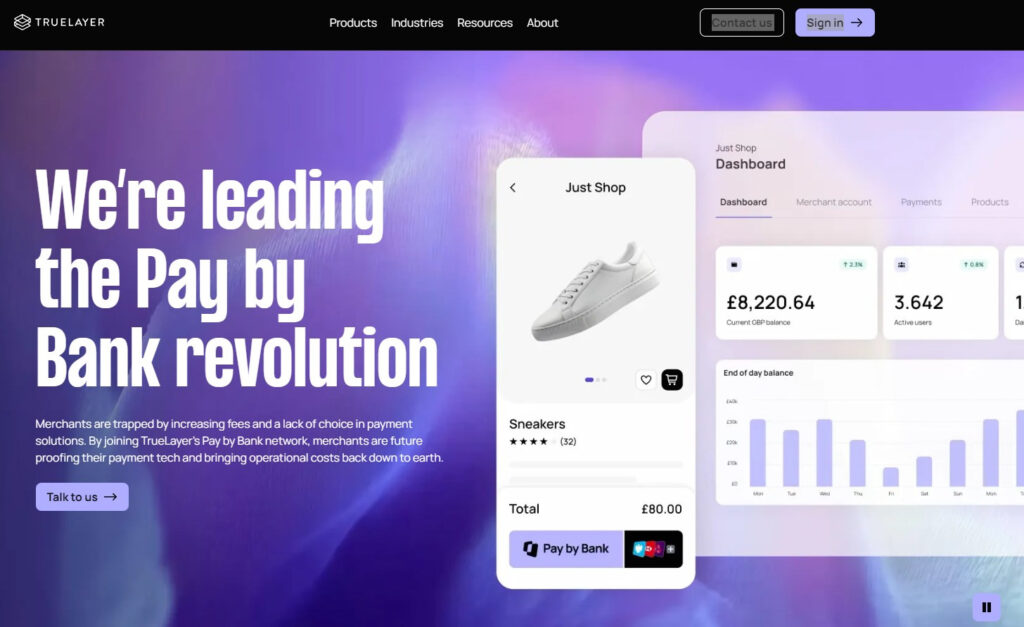
The provider table includes useful details for ERP reconciliation workflows. Platforms can see which banks return account holder names through the AIS API. Payment status indicators show whether a transaction has reached “executed” or remains in “authorised” state.
- Transaction history visibility: Each bank listing shows how far back transaction data can be retrieved.
- Filter by product: Search for providers that support both AIS and PIS in specific countries.
- Market share sorting: Rank banks by market share to prioritise integration coverage.
TrueLayer’s documentation gives accounting platforms transparency that most competitors keep behind sales calls. Engineers can verify bank support before committing to integration work.
Where this payment initiation firm shines: Complete visibility into bank-level capabilities before deployment.
3. Yapily – An AIS and PIS Provider With Eight Accounting Use Cases
Yapily is an open banking company that published eight detailed ways the technology transforms accounting businesses. The list moves beyond generic statements into concrete workflow improvements.
Bank account validation happens instantly through Yapily Validate. Suppliers verify their bank accounts directly on the platform, eliminating invoice fraud risk. Financial data aggregation pulls real-time feeds from connected accounts, replacing manual statement uploads.
- Efficiency claim: Open banking can reduce accounting operations by up to 80 percent compared to legacy methods
- Bulk payments: A single transaction initiates payments from one account to multiple recipients, cutting processing fees
- VRP for subscriptions: Variable Recurring Payments automate account top-ups for UK customers
Accounting firms using Yapily can offer clients personalised financial planning tools based on real-time cash flow data. The platform serves over 2,000 banks across 19 countries.
Why this AIS and PIS provider fits accounting workflows: Eight documented use cases with specific automation outcomes for each.
4. Tink – A Pan-European Open Banking Firm With Single API Integration
Tink demonstrated its platform at FinovateEurope 2018 and has since built a single API layer for account aggregation and payment initiation across Europe. The company partnered with Mash, a Finnish consumer lending platform, to improve onboarding and provide better control over financial accounts.
The Mash integration shows how accounting platforms can use Tink’s technology. Customers connect their bank accounts once. Tink handles the authentication journey through its Link SDK, which works across different banks and markets.
- Data enrichment: Transaction categorisation ensures accuracy for accounting workflows.
- Unified authentication: Single user journey works regardless of which bank the customer uses.
- Cloud-based infrastructure: No on-premise requirements for accounting platforms.
Tink raised $63 million in new funding and expanded into five additional European markets in early 2019. Visa acquired the company in 2022, integrating Tink as its strategic open banking platform for Europe.
What this open banking firm offers accounting platforms: Pan-European connectivity means one integration covers multiple countries.
5. Salt Edge – Partner Programme for Platforms Without Licences
Salt Edge takes a different approach to AIS and PIS delivery. The company operates an Open Banking Gateway that provides access to bank accounts in Europe and beyond through a unified API.
The Partner Programme matters for accounting platforms that do not hold their own open banking licences. Salt Edge allows partners to use the same APIs under Salt Edge’s licence, enabling secure access to PSD2 channels without becoming a regulated TPP.
- Licensing flexibility: Platforms skip the regulatory overhead of becoming their own payment institution.
- Data enrichment platform: Raw transaction data transforms into insights through categorisation and merchant identification APIs.
- Financial insights generation: Algorithms produce customer financial behaviour profiles.
The transaction categorisation API handles personal and business transactions. Merchant identification determines exact transaction locations and provides detailed merchant information.
Why this data aggregation firm works for smaller platforms: Access to PSD2 channels without holding a licence.
6. GoCardless – Bank Institution Data for Payment and Information Services
GoCardless maintains a structured institution resource that accounting platforms can query to check bank support before initiating payments or requesting data. The institution object includes country codes, status indicators, and flags showing whether a bank supports AIS, PIS, or both.
Each institution has an enabled, disabled, or temporarily disabled status. Platforms can check this status through the API before attempting connections.
- Auto-complete flag: Shows whether the institution returns payer bank account details during collection.
- Icon and logo URLs: Visual assets for displaying bank selection screens within accounting software.
- Country-specific filtering: Institutions organised by ISO 3166-1 alpha-2 country codes.
GoCardless started as a direct debit platform but has expanded into open banking payments. The institution data helps accounting platforms decide which banks to prioritise for integration.
What this payment provider delivers for ERP software: Structured bank data that helps platforms manage institution-level support decisions.
What Accounting and ERP Platforms Need From AIS and PIS Providers
Any AIS and PIS provider serving accounting firms needs to deliver five specific things. Financial workflows have specific requirements that other industries do not share.
Structured data outputs matter more than raw transaction access. Accounting systems need merchant names, category codes, and consistent field mapping. Raw bank data with inconsistent formatting creates reconciliation headaches instead of solving them.
Transaction history depth separates real automation from partial fixes. A platform pulling only 90 days of history cannot support annual reporting or multi-period audit trails.
Payment initiation must happen inside the workflow. Sending users to a banking portal breaks the automation chain. The payment step belongs inside the ERP interface.
White-label consent keeps the platform’s brand visible. Every bank authentication screen that carries another company’s name confuses customers and dilutes trust.
UK coverage needs to be complete, not partial. An accounting platform serving UK businesses cannot tell customers their bank is not supported.
Wrapping Up
Accounting and ERP companies face a straightforward choice when selecting an open banking firm. Build bank connectivity in-house or buy it from an API provider.
Building means months of engineering time, compliance reviews for each bank, and ongoing maintenance as banking APIs change. Buying means finding a provider that matches the platform’s specific requirements.
Finexer stands as the best provider for UK accounting and ERP companies specifically. One API covers transaction data retrieval and payment initiation. Ninety-nine percent bank coverage. Transaction history up to seven years. White-label consent screens. Backed by SFC Capital and the British Business Bank.
TrueLayer brings enterprise-grade documentation and bank-level transparency. Yapily offers eight concrete use cases for accounting automation. Tink provides pan-European coverage through a single API. Salt Edge lets smaller platforms skip the licensing process. GoCardless delivers structured bank data for institution-level decisions.
Pick the AIS and PIS provider that already solved the problems your accounting platform faces today. The right partner makes reconciliation automatic. The wrong one adds another integration to manage.